Following WWII, the cereal industry saw a new market: Children. With the continuation of the 40’s/50’s baby-room, breakfast cereal companies began marketing their new products (now with more sugar) on television, in newspapers, billboards, etc.
In the 1922, the hugely successful Battle Creek Toasted Corn Flake Company was renamed the Kellogg Company after its founders Will Keith Kellogg and his brother John Harvey Kellogg. In the 1950s, the Kellogg Company established itself as a dominant economic force with the introduction of several new cereal brands and a line-up of new animate mascots marketed towards children.
Kellogg’s New 1950s Cereals Brands Sugar Smacks (now called Honey Smacks), whose mascot went from Cliffy the Clown in 1949 to Smaxey, sailor-suit-wearing seal: http://www.youtube.com/watch?v=_9WkLVZrrSI http://www.youtube.com/watch?v=-4mRDcOD2g4
Sugar Pops (now called Corn Pops): http://www.youtube.com/watch?v=vZ5CPCvf6aA
And most famously: Sugar Frosted Flakes (now just called Frosted Flakes, featuring Tony Tiger who later became a cultural icon. Frosted Flakes is one of few major cereal brands to keep the same mascot since its introduction. Thurl Ravenscroft remained the voice of Tony the Tiger until his death in 2005. http://www.youtube.com/watch?v=yUxnpQFlsS4
General Mills, who already dominated the breakfast cereal industry, introduced Trix in 1954, Cocoa Puffs in 1958, and Total in 1961 (videos at the bottom) And also starting in the 1950s, General Mills used “The Cheerios Kid” as their mascot for the already widely popular product: http://www.youtube.com/watch?v=VRm9BPxc94k This was in response to Kellogg’s cereals animated mascots.
First off, it's interesting to note that the term 'jello' has become interchangeable with the term 'gelatin'. Many cookbooks use 'jello' as a term, assuming the reader knows what is being referenced. "It would seem that America has pretty much an insatiable appetite for the salad/dessert that jiggles." During the 1970's, there were surveys conduced on the American public that said that the reason Jell-O was so popular because of its emotional ties rather than its versatility. But why does Jell-O have such emotional ties to the average Americans? The 1930s promoted the speediness of Jell-O; during the 1950s, the Jell-O campaign promoted the 'cooking' of Jell-O would make the average housewife more creative and fun. Many people considered it to be the height of sophistication. However, as decades passed, Jell-O shifted from a high-end, sophisticated snack to a simple, plain and almost embarrassing meal. It showed that people were unable to afford anything more expensive than Jell-O. Artists like Norman Rockwell and Maxfield Parrish made advertisements and the cover of many Jell-O cookbooks. Studies show that Jell-O reminds people of their childhood: Jell-O is a staple of very young childhood, when children are first learning how to feed themselves. Many interviewees recall how Jell-O feeds into many family traditions. It really resonates more to suburban families than to city ones; wives had to prepare food and it had to be made as quickly as possible.
These collages try to emphasize the ways in which food (mainly processed) was pictured and viewed in the 1950's. Food was made to look colorful, inviting, and luxurious, and the purchase and consumption of these new, innovative products was meant to reflect one's presumably white, middle class status (for that is who these ad's were made for). These ads reinforced gender roles by always addressing women as the kitchen dwellers, with happy husbands beaming at cakes and accepting plates of fried chicken (see collage 3). Interestingly, almost all alcohol ads I saw were for either whiskey or beer, and clearly targeted at men. They appealed to the "good judgement" of men, and pictured cocktail party type gatherings of men.
After reading through the chapter on McDonald's in The Fifties, David Halberstam's huge book which the T.A.'s have been carrying around with them, I thought some of the original goals of the McDonald brothers and Ray Kroc would be interesting to note in comparison to the ideals championed in the modern era of fast food. One of the first things which caught my eye was the McDonald Brother's close eye for changing social trends- they realized that the world was becoming a faster place, and they knew their customers would appreciate the quickest service possible. This led them to do away with carhops, the waitresses who would bring the food out to the family vehicle. They also sold hamburgers simply because it was the bulk of their business and they were desperate to streamline as much as possible.
This is the point where things get interesting. They were the first food chain to mechanize the assembly process for their food, enlisting a friend of theirs with inventing experience to craft custom machines which measured the perfect amount of meat in each patty and the perfect amount of ketchup, mustard and pickles on each burger. Making the move to paper plates and silverware allowed them to stop washing dishes, another time and money saver. The McDonald brothers also began using infrared lights to keep the food warm, which allowed the less busy times of the day to be used preparing for the rush hours. All these changes can be seen as Henry Ford's mechanized assembly line finding a new home in the burger business.
Another interesting note is McDonald's early focus on being a family restaurant. They did not allow women to be the cashiers because they would flirt too much and attract idle teenage boys who would scare away families. They also removed the condiment station from their restaurant in order to eliminate the messiest part of the operation.
What influenced the policies of McDonald's more than anything else, however, was the institutionalization of methodology brought on by Ray Kroc. He initially learned of their amazing success through his previous job selling milkshake mixing machines to restaurants, but even those were modified to suit McDonald's specific needs. Within a very short while Kroc became the head of franchising for the brothers, who were more concerned with their original store.
Kroc's obsession with cleanliness and standardization marked the beginning of an era- even after hundreds of McDonalds had began operating in the country, he would still walk from his office in McDonald headquarters down to the nearest restaurant, picking up McDonald's garbage on his way to help them close the store properly. Even after becoming a millionaire, he would still patrol the tables for unused salt and ketchup packets which could be re-stocked. It was also Kroc's idea to place them primarily in suburban neighborhoods, which he viewed as safeguarded from the young, roaming deviants he disliked hanging around their stores.
in 1958, Kroc discovered a McDonald's in California was selling their burgers at 19 cents a piece instead of the standard 15, which led him to mistrust "non-conformists" and made this demand to conform: "You cannot give them an inch. The organization cannot trust the individual; the individual must trust the organization or he shouldn't go into this kind of business." This incident lead him to temporarily stop new franchising operations in all of California, believing it to be a home for deviancy.
to close this discussion of early Mcdonald's values, i simply present some facts- thirty-seven years after Kroc took over franchising, 8,600 McDonald's existed in the US and 12,000 more outside the country. Clearly, Kroc's influence on the way we view food is staggering.
Found a blog entry with a recipe (or at least a variation of one) from Poppy Cannon's, 1952 The Can-Opener Cook Book:
A delightful warm weather soup with an unusual garnish. You Will Need: bottled clam juice canned vegetable cocktail (I prefer the glass:) cucumber ice Tabasco Sauce Combine equal parts icy cold clam juice and very cold canned vegetable cocktail (V8?), season with a little extra salt and pepper, if desired, and a few drops of Tabasco sauce. At serving time, Serve in glass or china cup or bowl, adding to each portion a spoonful of crushed ice and a spoonful of finely cut, unpeeled cucumber. Note: If you have no ice-crushing machine you can crush ice cubes by placing them in a small canvas bag and hitting several times with a hammer or any other heavy object. 1953 remember:)
so this doesn't have much to do with my particular focus, but the bottom of this page has a link to an article defining each decade from 1950-1990 with one specific food. the fifties is of course the jello casserole, and the small piece on it could be interesting for those of you who can't get enough of the best dish ever. Has some good points as to how casseroles were viewed at the time and why they were so popular.
In the Cold War era, amidst nationalism and patriotism, the woman was seen as important because she could lead the family against liberalism, socialism, and communism. In her marriage and motherhood, the housewife kept the family together which would help keep the nation strong. With postwar prosperity offering new opportunities and domesticity being stressed, many women of the Cold War age found themselves whisked off to the suburbs, where they were sold new ideas about the family meals that were their most important undertaking by companies of mass-produced packaged food.
FASHIONABLE FOOD
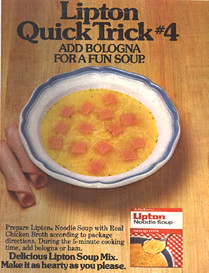
In the 1950s bologna soup, the ‘Emergency Steak’ type of food found in Betty Crocker recipes, and other kinds of ‘mock dishes’ and recipes that bore fancy names yet consisted solely of canned ingredients were prevalent in cookbooks. In 1957 the French philosopher Roland Barthes described such recipes as ‘ornamental cookery.’ He asserted that in ornamental cookery ‘there is an obvious endeavor to glaze surfaces, round them off, to bury the food under the even sediment of sauces, creams, icing and jellies.’
·-sticking shrimps in a lemon
·-making a chicken look pink
·-serving grapefruit hot
·-Tuna noodle casserole with crushed potato chip topping
·-Jell-O rings
Like the photographs in cookbooks, many 1950s recipes advocated foods that could be served as proud displays of Technicolor splendor (and uniformity). There was an ideal way to present almost any meal. For example, chicken a la king was supposed to be arranged in or upon edible cups, timbales, or decorative rings of pastry that did not require lots of fuss. Neuhaus describes it as, “a visual symphony in purest white, accented by grace notes of scarlet pimento and green pepper. In the classic 1950s presentation, chicken a la king looked like Abstract Expressionist color drips applied to a dinner plate, so completely were its properties as food overwhelmed by its pictorial charm.”
FOOD FASHION
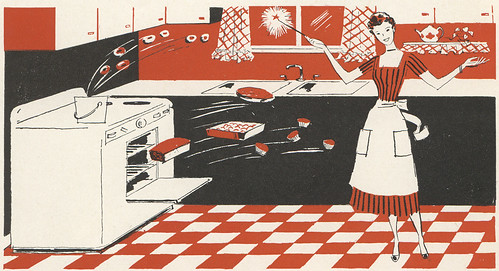
In the 1950s cooking was viewed by women as an outlet for creativity that was nonetheless encouraged in very structured and controlled ways by advertisers and cookbook authors. Suggestions for creativity with food were often specific, direct, and delivered in such a way as to imply women’s overall ineptitude at executing independent thought.
For example, theme parties were incredibly popular, and cookbooks described to the last detail how a woman could hold the perfect cocktail party, buffet supper, backyard barbecue, Hawaiian, Mardi Gras, fondue party... These them party menus came complete with directions on how to elaborately decorate the food and display it properly.
Women’s effectiveness and personal satisfaction in the kitchen, and thus, for many, in life, was not judged solely by their efficiency or cooking abilities. Cookbooks also suggested appropriate attire, as a connection was seen between women’s clothes and their family’s appetite and happiness. For example, Betty Crocker recommended that women should wear nice clothes and makeup in the kitchen because it would enhance their family’s enjoyment of their food:
“Every morning before breakfast, comb hair, apply makeup and a dash of cologne. Does wonders for your morale and your family’s too!”
SOURCES
Inness, Sherrie A., Kitchen culture in America. (University of Pennsylvania Press,
2001). Marling, Karal Ann, As seen on TV. (Harvard University Press, 1996). Neuhaus, Jessamyn, “The Way to a Man's Heart: Gender Roles, Domestic Ideology, and
Cookbooks in the 1950s.” Journal of Social History 32, no. 3 (Spring 1999): 529-555.
Ogden, Annegret S., The great American housewife. (Greenwood Publishing Group, 1986).
Previously I posted the poem Domestic Villanella by the canned food, cooking guru, Poppy Cannon. The poem was written to her long time lover and prominent figure of the NAACP, Walter White. As a black man with light skin White was able to gather information on lynchings taking place in small southern towns. He publicized the atrocities he had investigated and went on to lead the NAACP for over twenty years.
Cannon and White’s relationship began while they were both married and the exposure of their affair would mean White’s removal from the organization. Poppy went on to write several books, her most famous being The Can-Opener Cookbook. Though she was well educated in the culinary world Her work was not always taken very seriously in the world of gastronomy, because her commitment was to the everyday woman in the kitchen. She was dedicated to creating shortcuts in order to save time, but was also a proponent of the marketplace and worked for Heinz and General Foods. It was when Cannon and White were finally married that she began producing poetry as an addendum to her recipes in her book The Bride’s Cookbook…
(Will add more tomorrow. Going to get some recipes from this cookbook)
A key aspect of the rise of consumer culture in the 1950's was the transformation of the food industry. In my last post I covered the rise of supermarkets within suburban and urban areas. As supermarkets allowed for a drastic change in the way consumers purchased food, the food products sold in supermarkets transformed the way in which people ate. A significant market that gained popularity in the 1950's was canned and processed foods. One of the most popular processed food products was the first meat to be successfully canned and marketed: Spam. Spam was developed and marketed by the Hormel Foods Corporation of Austin, Minnesota and debuted in 1937. It was marketed to domestic consumer markets throughout World War II, though was primarily used as rations for overseas troops during the war. Over 100 million pounds of Spam were shipped to allied forces over the course of the war. As the war ended and processed food became increasingly popular in the United States, Spam quickly gained popularity as a household staple. It was praised for its efficiency and ease of use in simplifying the cooking process. As a New York Times article from July 6, 1950 states, "Besides economy and household acceptance, there is another virtue of appeal to all kitcheners at this season - ease of preparation. When all the cooking's been done for you, then there's no need to stand over a hot stove - than which there is no worse abomination in a small city apartment" (Nickerson 1950, 32). Spam is made up of several types of pork, salt, water, sugar, and sodium nitrate. What was lost in the quality of meat was made up for by convenience and efficiency. Though by today's standards that might seem an unfortunate trade-off, the novelty of Spam proved integral in its marketability and success in the 1950's. Above is a recipe calling for canned meat product in the New York Times from 1950.
In the mid 19th century, marshmallow candy was made using the sap of the Marsh-Mallow plant, a medicinal plant of African origin found in marshes. Gelatin replaced the sap in the modern recipes, which are a mixture of corn syrup or sugar, gum Arabic, gelatin and various flavorings.
In 1948 Alex Doumak, a marshmallow manufacturer developed a new way of producing marshmallows as an “extrusion process” and by fitting the fluffy mixtures through tubes and cutting them into cylindrical shapes as we see them today.
The Rodda Candy Company, a small company based in Lancaster, Pennsylvania, invented the first marshmallow chicks we know today as Peeps. In 1953, Bob Born of the Just Born Company bought Rodda Candy and within a year had produced a machine that could mass-produce the marshmallows chicks, which he trademarked as Peeps.
Peeps have a terrifyingly influential status in American culture—as described in the documentary “The Power of the Peep.” A teaser is available here: http://www.powerofthepeep.com/teaser.html
Since the 1950s, it's clear which of the two trends in fast food dining -- the urban-born Automat cafeteria and the suburban-born drive-in & drive-through burger joint -- has come to dominate. The interesting thing is that this is the case both in suburban and urban environments. In the 1950s, there existed a distinctive model suited to both environments, but today, it seems we've taken a model from one and adapted it to the other.
What is implicitly suggested by this is that the suburban lifestyle or values of visible but isolated consumption inaugurated in the '50s has, to some degree, become the norm outside of its physical boundaries. Today, in cities all over America, we see McDonalds and other fast food restaurants (originally seen as stand-alone burger establishments in the open spaces of the suburbs, accessible by car) crammed into storefronts.
There is somehow a significant difference, it seems, from Automat culture at work in these establishments. The reliably bright, family-friendly ambiance even seems to set the tone of the place. Automats were a fast food experience that was more "adult:" the fast food we see today carries a child-like aesthetics, and therefore informs the type of interactions had in those restaurants. The counter-service also provides a level of surveillance that contrasts with the Automat's anonymity. It seems the '50s heyday of the shifty Herbert Hunckes and Bill Burroughses of the world loitering all night in metropolitan fast food establishments is gone for good.
Who were food advertisements geared towards in the 1950's? What kind of consumers were expected to buy these food products? After looking through various food ads from the time period, one can clearly see who was expected to respond to them. These ads were geared towards women, presumably those who didn't work and had time for magazines, those who did the grocery shopping and cooking for their families. Food ads during the 1950's have the overwhelming theme of the beautiful housewife in heels and dresses, setting colorful feasts down on a table for a perfect nuclear family, usually never shown participating in the meals herself. Of course the women in these ads are delighted at the incredible wide ranging versatility of spam and jello, how it pleases their families and impresses their dinner guests.
These advertisements reinforce what it meant to be a perfect American housewife, belonging to nuclear families, always in suburban homes, and set up a situation in which the typical female consumer is expected to place herself within the ad, identifying with the happy obliging image of a wife, maintaining her place in society.
A critical aspect in the development of the food industry in the United States during the 1950’s was the creation of the indoor supermarket. Supermarkets originated as early as the 1930’s, yet did not begin to gain in popularity or grow into their modern form until the post-World War II era.
Several factors contributed to the rise of supermarkets in the 1950’s. The expansion of suburban living areas was one of the greatest contributions to their rise. Supermarkets needed large areas to build stores and the necessary open land could be found in open developing areas where land was cheap. They could also be surrounded by parking lots, attracting the new population of car drivers. Supermarkets were soon seen to turn quick profits as operating costs remained low due to the role of customers in picking out and packaging their own food, a difference from the open-air markets that preceded them. Supermarkets also were able to profit from the sheer volume of products provided at low prices. A significant aspect of the low cost of food was the increase in branded and packaged foods, a trend that will be examined in future posts.
All of these factors combined to create a booming expansion of the supermarket industry during the 1950’s. According to a New York Times article from January 3rd, 1950, Food Fair Stores began investing heavily in indoor supermarkets at the top of the decade. As the article states, the company’s new supermarket program “will involve the expenditure of more than $5 million during the next year or more, and possibly $12 million within the next three years.Most of this outlay will be for the construction of modern supermarkets” (New York Times, 1950). Overall, economic and social factors contributed to the rise of supermarkets during the 1950’s and set the stage for significant change in the food industry as the decade moved on.
The Automat may have represented the pinnacle of modern convenience in a pedestrian, urban setting, but the setting of the 1950s was increasingly neither pedestrian nor urban. In the 1950s, the popular imagination, popular culture depictions, and many real people began to move to the celebrated new hybrid of the city and the country: the suburbs.
In this new suburban environment, homes were all grouped together in massive residential developments, and places of commerce, work and recreation were elsewhere - often in the adjacent cities - and certainly not within walking distance. Therefore, suburbanites were increasingly dependent on the vehicle of the American Dream: the automobile.
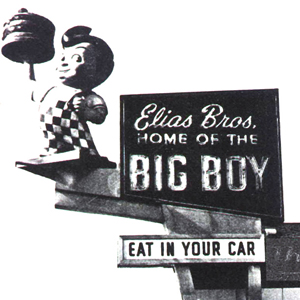
Fast food had to accommodate this, and the 1950s saw the explosion of stand-alone burger joints, may of which employed drive-through or drive-in models. The drive-through, where cars pass by a window, receive food, and keep going would eventually become the dominant model, but what was very popular in the '50s was the drive-in: where cars would park outside the restaurant and food was brought to customers who would eat in their cars.
This process contrasted sharply with the Automat, where one dispensed the food oneself, and could loiter in a crowded and anonymous cafeteria space at any hour of the day or night. Like everything in the suburbs, the drive-in was promoted as more 'safe,' domestic, family-oriented (can you imagine Bill Burroughs going to cop at a drive-in?). The drive-in was a visible space, at once public (cars, often convertibles, lined up alongside each other) and also extremely individual (families or groups of kids confining themselves to their own cars): a perfect example of the trend of suburbanization.
While we're on the subject of corporations, advertising, and food, I found this interesting blogpost on the origin and evolution of some of our favorite corporate mascots, many of whom have significant ties to the 1950's decade.
More cookbooks—containing photos, detailed recipes, kitchen instruction, and corporate advertising—poured onto the market during the 1950’s than at any previous time in US history. These cookbooks often served as domestic advice manuals for women; authors would usually include specific directions and advice for women’s cooking and other duties. According to Leavitt, domestic advisors selling such prescriptive rhetoric to women have “always remained engaged in their culture and aware of important issues…they helped educate women about sanitation and design, patriotism, religion, and the family.” The most celebrated domestic advisor/mythical mother figure of the 1950s was the fictional Betty Crocker, who had a best-selling cookbook named after (and “written by”) her.
Betty Crocker's Picture Cook Book "showed just how much home cooks wanted the simply phrased reassurance and reliable advice” they associated with Betty Crocker. Horner posits that the text within the famous cookbook reflects “the cultural preoccupation with women’s roles after the end of World War II.” Through both anecdotal writing and cutesy illustrations (of American folk tales and gender roles being played out), Betty Crocker’s Picture Cook Book linked domestic tasks with the restorative notion of returning to the United States’ humble origins during the postwar search for national renewal. Uniquely American foods and practices are emphasized amongst allusions to early American history—George Washington appears five separate times.
The book alludes to the prevalent themes of sacrifice, regeneration, and women’s responsibility to enact rituals of fertility and appeasement in the wake of the damages of the war and the reintegration of over 11 million U.S. servicemen into domestic life. It specifies the bodily practice of cooking as a traditionally feminine practice important for the maintenance of family life and thus the nation.
From the introduction to the Yeast Bread section:
The memory of a cozy kitchen filled with the warm fragrance of freshly baked bread still means home…today’s homemaker who wants to give her family the cozy comfort of freshly baked bread can make it much more easily and quickly than ever before.
Through the practice of baking bread and making a “cozy” home, the housewife does her part to usher in the rise of a renewed civilization after the war. The text admits that bakeries often offer better baked goods, however the labor, the physical engagement of the woman’s body, that goes into the preparation of the bread is as meaningful to the cozy atmosphere as the warm fragrance itself.
***
Images from the original Betty Crocker's Picture Cook Book
Crocker, Betty, Betty Crocker's Picture Cookbook. (John Wiley & Sons, 1998).
Sources:
Horner, Jennifer R., “Betty Crocker’s Picture Cookbook: A Gendered Ritual Response to Social Crises of the Postwar Era.”
Journal of Communication Inquiry, Vol. 24, No. 3, 2000.
Leavitt, Sarah Abigail, From Catharine Beecher to Martha Stewart. (UNC Press, 2002).
Neuhaus, Jessamyn. “The Way to a Man's Heart: Gender Roles, Domestic Ideology, and Cookbooks in the 1950s.” Journal of
Social History, Vol. 32, 1999
Shapiro, Laura, “"I Guarantee": Betty Crocker and the Woman in the Kitchen,” in From Betty Crocker to feminist food studies:
critical perspectives on women and food, (Liverpool University Press, 2005)